
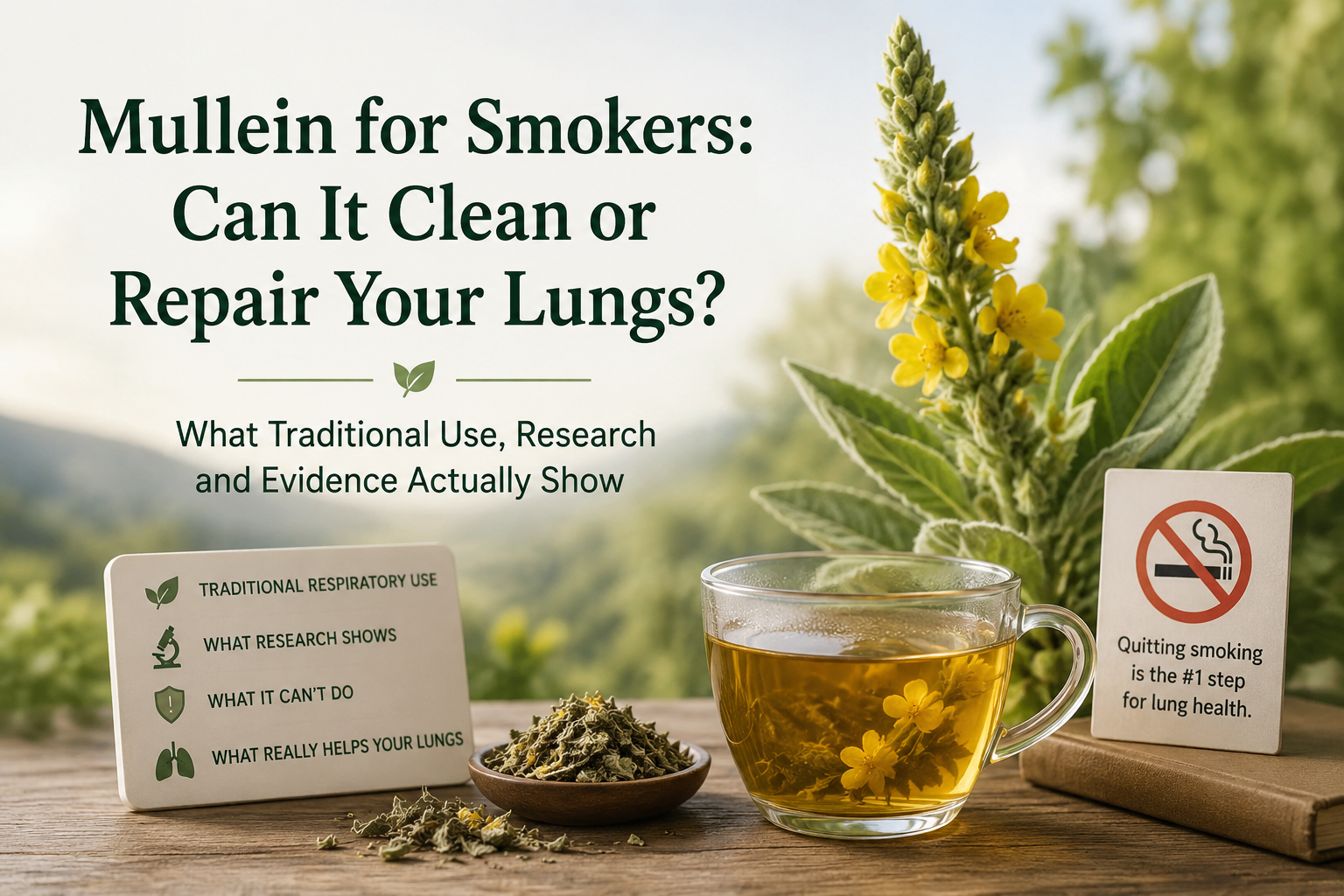
Quick answer: Mullein has a long history of traditional respiratory use, but there is no good clinical evidence that mullein cleans smokers’ lungs, removes cigarette tar, repairs smoking-related lung damage or reverses COPD. The most evidence-based step for protecting and recovering lung health is stopping exposure to tobacco smoke.
Some smokers and ex-smokers use mullein tea, tinctures or other products because of the herb’s association with cough, mucus and respiratory comfort. These uses should be understood as traditional or supportive—not as proven lung detoxification.
Mullein for smokers — what are you actually trying to address?
| Question | Evidence-based answer | Best guide |
|---|---|---|
| Can mullein clean smokers’ lungs? | No good clinical evidence shows that mullein removes tar, toxins or damaged tissue from the lungs. | Lung Detox Claims |
| Can mullein help smoker’s mucus? | Mullein has a traditional expectorant reputation, but reliable mucus clearance has not been established in strong human trials. | Mullein for Mucus |
| Can mullein repair smoking damage? | No evidence shows that mullein reverses structural lung damage caused by smoking. | Mullein & Lung Evidence |
| What about coughing after quitting? | Changes in mucus clearance can occur after smoking cessation as airway function begins to recover. This is not proof of a herbal “detox.” | Mullein for Cough |
| Should ex-smokers smoke mullein? | Burning mullein still creates smoke exposure and should not be described as a lung-recovery strategy. | Mullein Smoking |
Bottom line: mullein may be used traditionally for respiratory comfort, but smoking cessation—not mullein—is the intervention with strong evidence for reducing smoking-related respiratory risk.
Short answer: Mullein has a long history of traditional respiratory use, which helps explain why it is popular among smokers and former smokers. However, there is currently no good clinical evidence showing that mullein can “clean” the lungs, remove smoking toxins, reverse smoking-related lung damage or repair damaged lung tissue.
For people who smoke, the most important evidence-based step for protecting the lungs is reducing and ultimately stopping exposure to cigarette smoke.
That does not mean mullein has no history or scientific interest. It means we need to separate what is traditionally associated with the herb from what has actually been demonstrated in humans.
Why Do Smokers Use Mullein?
People who smoke or recently stopped smoking often become more aware of coughing, mucus, throat irritation or breathing changes. At the same time, mullein is widely associated with traditional respiratory herbal practice.
That combination has created a growing interest in mullein for smokers.
Common searches include:
- Is mullein good for smokers?
- Does mullein clean smokers’ lungs?
- Can mullein repair lung damage from smoking?
- Does mullein remove mucus?
- Is mullein good after quitting smoking?
- Can mullein detox your lungs?
These are reasonable questions, but they do not all have the same answer.
To understand why, start with our broader guide: Is Mullein Good for Your Lungs?
What Is Mullein Traditionally Used For?
Mullein, particularly species such as Verbascum thapsus, has a long history in European and other herbal traditions.
The European Medicines Agency recognizes mullein flower as a traditional herbal medicinal product for relief of sore throat associated with dry cough and cold.
However, the key word is traditional.
The EMA specifically notes that this conclusion is based on long-standing use rather than strong clinical trial evidence, and that clinical studies involving mullein flower medicines are lacking.
So it is reasonable to say:
- Mullein has an established history of respiratory use.
- It has traditionally been associated with cough and throat discomfort.
It is not reasonable to turn that history into claims that mullein has been proven to repair smokers’ lungs.
Does Mullein Clean Smokers’ Lungs?
There is no established medical evidence that mullein “cleans” smokers’ lungs.
The phrase clean your lungs sounds simple, but it is not a clearly defined clinical outcome.
Your respiratory system already has biological mechanisms that help move mucus and trapped particles. Smoking can interfere with normal respiratory function and expose lung tissue to thousands of chemicals.
Taking an herb does not simply wash those exposures out of the lungs.
Claims such as:
- “mullein flushes cigarette toxins from the lungs”
- “mullein cleans nicotine from your lungs”
- “mullein removes tar from the lungs”
go beyond what current research can support.
Can Mullein Detox Your Lungs?
There is no established clinical evidence that mullein produces a specific “lung detox” effect.
“Detox” is frequently used in wellness marketing because it sounds intuitive, but the term is often poorly defined.
If someone means:
- reducing coughing,
- changing mucus production,
- improving lung function,
- removing chemicals deposited by cigarette smoke,
- or reversing tissue injury,
each of those would be a different biological outcome requiring its own clinical evidence.
They should not all be grouped together under one vague word such as “detox.”
Can Mullein Repair Lung Damage From Smoking?
There is currently insufficient evidence to say that mullein repairs lung damage caused by smoking.
Smoking-related damage can involve several different processes, including inflammation, airway changes, loss of lung function and increased risk of chronic disease.
Those changes are much more complex than simple irritation.
Laboratory studies involving plant extracts cannot establish that an herb regenerates damaged human lung tissue.
Traditional respiratory use is not the same thing as proven repair of smoking-related lung injury.
If you see a product claiming that mullein “repairs smokers’ lungs,” that statement should be treated cautiously unless it is supported by appropriate human clinical evidence.
What Does Scientific Research on Mullein Show?
Mullein is scientifically interesting.
Reviews of Verbascum thapsus describe a range of phytochemicals, including flavonoids, iridoids, phenylethanoid glycosides and saponins.
Experimental studies have investigated potential biological activities including antioxidant, anti-inflammatory, antimicrobial and other effects.
These findings may help researchers identify mechanisms worth studying further.
But they do not demonstrate that a smoker who drinks mullein tea or takes a mullein product will experience repaired lung tissue or improved lung function.
For a deeper explanation of this distinction, visit our Mullein Research guide.
What About Mucus?
One reason smokers may become interested in mullein is mucus.
Mullein is frequently described in herbal traditions as having expectorant or soothing properties.
However, strong human clinical evidence demonstrating that mullein reliably removes mucus from smokers’ lungs is lacking.
It is therefore more accurate to describe mucus-related effects as part of the herb’s traditional reputation rather than as a clinically proven result.
Why Can Coughing Change After Quitting Smoking?
Some people notice changes in cough or mucus after they stop smoking.
This can lead them to search for herbs they believe will “clean out” their lungs.
But changes following smoking cessation should not automatically be attributed to a supplement or herbal product.
Most importantly, stopping smoking itself is one of the most meaningful actions a smoker can take for respiratory health.
The U.S. Centers for Disease Control and Prevention states that quitting smoking:
- reduces the risk of developing COPD;
- slows COPD progression in people who already have the disease;
- reduces respiratory symptoms such as cough, sputum production and wheezing;
- reduces respiratory infections such as bronchitis and pneumonia.
These benefits are supported much more strongly than claims that mullein detoxifies smokers’ lungs.
Is Mullein Useful After Quitting Smoking?
Some former smokers choose mullein because they enjoy using herbal tea or because they are interested in its traditional respiratory history.
That is different from saying mullein is medically necessary for lung recovery.
If someone enjoys mullein tea as an herbal beverage, the product should still be evaluated on its ingredients and preparation.
It should not be marketed as a substitute for smoking cessation, medical evaluation or evidence-based respiratory care.
What About Mullein Tea for Smokers?
Mullein tea is one of the most traditional forms of the plant.
It is commonly prepared by steeping dried plant material in hot water.
Because mullein leaves naturally contain fine hairs, careful filtration is commonly recommended when preparing leaf tea.
For smokers, it is important to understand what tea can and cannot reasonably be expected to do.
| Claim | Evidence status |
|---|---|
| Mullein has traditional respiratory use | Yes |
| Mullein has traditionally been associated with cough and throat discomfort | Yes |
| Mullein tea removes tar from smokers’ lungs | Not established |
| Mullein tea detoxes cigarette chemicals from the lungs | Not established |
| Mullein tea repairs damaged lung tissue | Not established |
What About Mullein Inhalers?
Modern mullein inhalers and nicotine-free vape-style products should be considered separately from traditional mullein tea.
The fact that a botanical ingredient has historically been consumed orally does not establish that inhaling it has the same safety profile.
The route of exposure matters.
For an inhalation product, important questions include:
- What ingredients are present?
- Does the product contain nicotine?
- Does the device heat or aerosolize ingredients?
- What other flavoring or carrier ingredients are present?
- What evidence supports the product’s claims?
You can compare these different formats in our How to Use Mullein guide.
Is a Nicotine-Free Mullein Product Better Than Smoking Cigarettes?
This question needs careful wording.
Cigarette smoking is well established as harmful and is associated with serious respiratory, cardiovascular and cancer risks.
But describing another inhaled product as “nicotine-free” does not automatically prove that it is harmless or medically beneficial.
Different products require their own safety evaluation.
The safest conclusion is not to assume that the presence of mullein makes an inhaled product therapeutic.
Can Mullein Prevent COPD?
There is not sufficient evidence showing that mullein prevents COPD.
Smoking is a major risk factor for COPD, and stopping smoking is one of the most important established ways to reduce future risk.
Using an herbal product while continuing to smoke should not create the impression that smoking-related risk has been neutralized.
Can Mullein Reverse COPD?
No evidence establishes mullein as a treatment that reverses COPD.
COPD is a chronic respiratory disease that requires appropriate medical evaluation and management.
People experiencing persistent shortness of breath, chronic coughing, wheezing or reduced exercise tolerance should not rely on mullein as a substitute for medical assessment.
What Actually Helps Your Lungs After Smoking?
The strongest evidence begins with eliminating ongoing smoke exposure.
According to public-health guidance, quitting smoking provides respiratory benefits regardless of age or how long someone has smoked.
Evidence-supported priorities include:
- stopping cigarette smoking;
- avoiding secondhand smoke where possible;
- seeking evaluation for persistent respiratory symptoms;
- following treatment plans for diagnosed respiratory conditions;
- maintaining appropriate physical activity when medically suitable.
Mullein can be discussed within this broader context as a traditional botanical, not as a replacement for these measures.
When Should a Smoker See a Doctor?
Herbal products should not delay evaluation of concerning symptoms.
Seek appropriate medical care for symptoms such as:
- persistent or worsening shortness of breath;
- coughing up blood;
- unexplained chest pain;
- significant or persistent wheezing;
- a cough that does not resolve;
- unexplained weight loss;
- recurrent respiratory infections.
Bottom Line: Is Mullein Good for Smokers?
Mullein has a real history of traditional respiratory use and contains plant compounds that have attracted scientific interest.
That makes it understandable why smokers and former smokers are interested in the plant.
However, current evidence does not establish that mullein:
- cleans cigarette toxins from the lungs;
- removes tar;
- detoxifies the lungs;
- repairs smoking-related lung damage;
- reverses COPD;
- or makes continued cigarette smoking safer.
The evidence for quitting smoking is much stronger. Smoking cessation reduces respiratory risks and symptoms and remains one of the most important actions a smoker can take for lung health.
Mullein is best understood as a botanical with a long respiratory tradition and interesting preliminary science — not as a proven method for reversing the effects of smoking.
Next, read Is Mullein Safe? for side effects, interactions and format-specific precautions.
Is Mullein Good for Smokers?
Mullein is popular among smokers and former smokers because of its long respiratory herbal history, but that does not mean it has been clinically proven to reverse the effects of cigarette smoke.
Current evidence does not establish that mullein:
- removes cigarette tar from lung tissue;
- cleans nicotine or smoke chemicals from the lungs;
- repairs structural lung damage;
- restores lost lung function;
- reverses emphysema;
- or makes continued smoking safer.
The strongest evidence-based step for protecting smokers’ lungs remains stopping continued smoke exposure.
Mullein for Ex-Smokers After Quitting
Former smokers often search for mullein because coughing, mucus or breathing sensations can change after quitting.
This is an important distinction: changes after quitting should not automatically be attributed to mullein or another supplement.
The Centers for Disease Control and Prevention reports that smoking cessation reduces respiratory symptoms such as cough, sputum production and wheezing, and over time reduces respiratory disease risk.
Some people may still choose mullein tea or another oral herbal product because they enjoy it or are interested in its traditional respiratory use. That is different from saying the herb is required for lung recovery.
Can Mullein Help With Smokers’ Cough?
A smoker’s cough may reflect airway irritation, mucus changes, chronic bronchitis or another respiratory condition.
Mullein has traditional associations with cough, especially mullein flower in oral herbal preparations, but there is not strong clinical evidence showing that it reliably treats smoking-related cough.
For cough-specific evidence, see Mullein for Cough.
For dry cough specifically, see Mullein for Dry Cough.
Can Mullein Help Smokers Clear Mucus or Phlegm?
Smoking can affect mucus production and the normal mechanisms the airways use to move mucus and trapped particles.
Mullein has a traditional expectorant reputation, but there is insufficient human evidence showing that it reliably accelerates mucus clearance from smokers’ lungs.
A change in coughing or phlegm after quitting smoking should also not automatically be interpreted as a supplement “detoxing” the lungs.
See Does Mullein Help With Mucus?.
What Happens to Your Lungs After You Quit Smoking?
Smoking cessation produces measurable respiratory benefits that do not depend on taking mullein or another herbal product.
According to the U.S. Centers for Disease Control and Prevention, quitting smoking can:
- reduce cough;
- reduce sputum production;
- reduce wheezing;
- reduce respiratory infections such as bronchitis and pneumonia;
- reduce the risk of developing COPD;
- and slow loss of lung function in people who already have COPD.
The CDC also reports that coughing and shortness of breath often decrease during the first 1–12 months after quitting.
Some people notice temporary changes in coughing or mucus after quitting. This does not mean that a supplement is pulling “toxins” out of the lungs. Airway clearance mechanisms can change as smoke exposure stops.
The important distinction: normal recovery after smoking cessation should not be marketed as evidence that mullein is detoxifying the lungs.
Can Mullein Clean Smokers’ Lungs?
There is no good clinical evidence showing that mullein physically removes tar, nicotine, pollution particles or unspecified toxins from lung tissue.
The phrase “cleaning the lungs” is often used in wellness marketing, but it is not a single standardized medical outcome.
See Does Mullein Clean Your Lungs?.
Mullein Tea for Smokers
Mullein tea is one of the more traditional oral formats.
Someone who enjoys mullein tea may choose it as an herbal beverage, but it should not be presented as a way to cancel out cigarette exposure or reverse years of smoking-related damage.
For the full tea guide, see Mullein Tea for Lungs.
Mullein Extract and Capsules for Smokers
Concentrated extracts and capsules are increasingly marketed for respiratory wellness, but concentration does not establish a stronger lung-recovery effect.
There is no universal clinically established dose of mullein extract or capsules for repairing smokers’ lungs.
See Mullein Extract for Lungs and Mullein Capsules for Lungs.
Should Smokers Smoke Mullein?
Using mullein because of its respiratory reputation is different from burning and inhaling it.
Smoking mullein creates combustion smoke, and traditional oral-use evidence does not prove that inhaling burned mullein benefits smokers’ lungs.
See Mullein Smoking: Can You Smoke Mullein Safely?.
What About Mullein Vape for Smokers?
A nicotine-free mullein vape may avoid nicotine if its labeling is accurate, but “nicotine-free” does not establish a lung-health benefit.
Heated aerosol is a different exposure route from tea, extracts or capsules, and traditional evidence cannot automatically be transferred to vaping.
See Mullein Vape: Safety, Benefits Claims & Evidence.
What Actually Helps the Lungs After Quitting Smoking?
The strongest evidence supports eliminating ongoing cigarette exposure.
According to the CDC, quitting smoking:
- reduces the risk of developing COPD;
- slows COPD progression in people who already have the disease;
- reduces cough, sputum production and wheezing;
- reduces respiratory infections;
- and provides benefits regardless of age or how long someone has smoked.
Mullein should therefore be understood as a traditional botanical option rather than a proven replacement for smoking cessation or evidence-based respiratory care.
For the broader format comparison, see How to Use Mullein for Lungs.
More Questions About Mullein for Smokers
Is mullein good for smokers’ lungs?
Mullein has a traditional respiratory-use history, but strong human evidence does not show that it repairs smokers’ lungs, restores lost lung function or removes cigarette residue.
Is mullein good after quitting smoking?
Some former smokers choose mullein tea or supplements because of the herb’s respiratory tradition. However, the established respiratory benefits after quitting come primarily from stopping smoke exposure itself rather than from mullein.
Can mullein repair lungs after smoking?
There is insufficient clinical evidence showing that mullein repairs structural smoking-related lung damage or reverses emphysema or COPD.
Does mullein remove tar from the lungs?
No good human clinical evidence shows that mullein removes cigarette tar from lung tissue.
Can mullein help smokers cough up mucus?
Mullein has a traditional expectorant reputation, but reliable clinical evidence showing that it increases mucus clearance in smokers is limited.
How long does it take for lungs to recover after quitting smoking?
Recovery varies by person and by the type of smoking-related change. The CDC reports that coughing and shortness of breath can decrease over the first 1 to 12 months after quitting, while reductions in disease risk continue over much longer periods.
Should ex-smokers use mullein tea or extract?
There is not enough evidence to say that tea or extract is superior for lung recovery after smoking. Product choice should not be confused with a proven treatment effect.
Can mullein prevent COPD in smokers?
Mullein has not been established as a way to prevent COPD. Stopping cigarette smoking is one of the most important evidence-based ways to reduce COPD risk.
For smoking-related chronic airflow disease, see Mullein for COPD.
References
- European Medicines Agency. Verbasci flos — Mullein Flower. Committee on Herbal Medicinal Products. European Union herbal monograph.
- Gupta A, Atkinson AN, Pandey AK, Bishayee A. Health-promoting and disease-mitigating potential of Verbascum thapsus L. (common mullein): A review. Phytotherapy Research. 2022;36(4):1507–1522. DOI: 10.1002/ptr.7393.
- Centers for Disease Control and Prevention. Benefits of Quitting Smoking. Smoking and Tobacco Use.
Additional Smoking-Cessation Source
Centers for Disease Control and Prevention.
Benefits of Quitting Smoking