
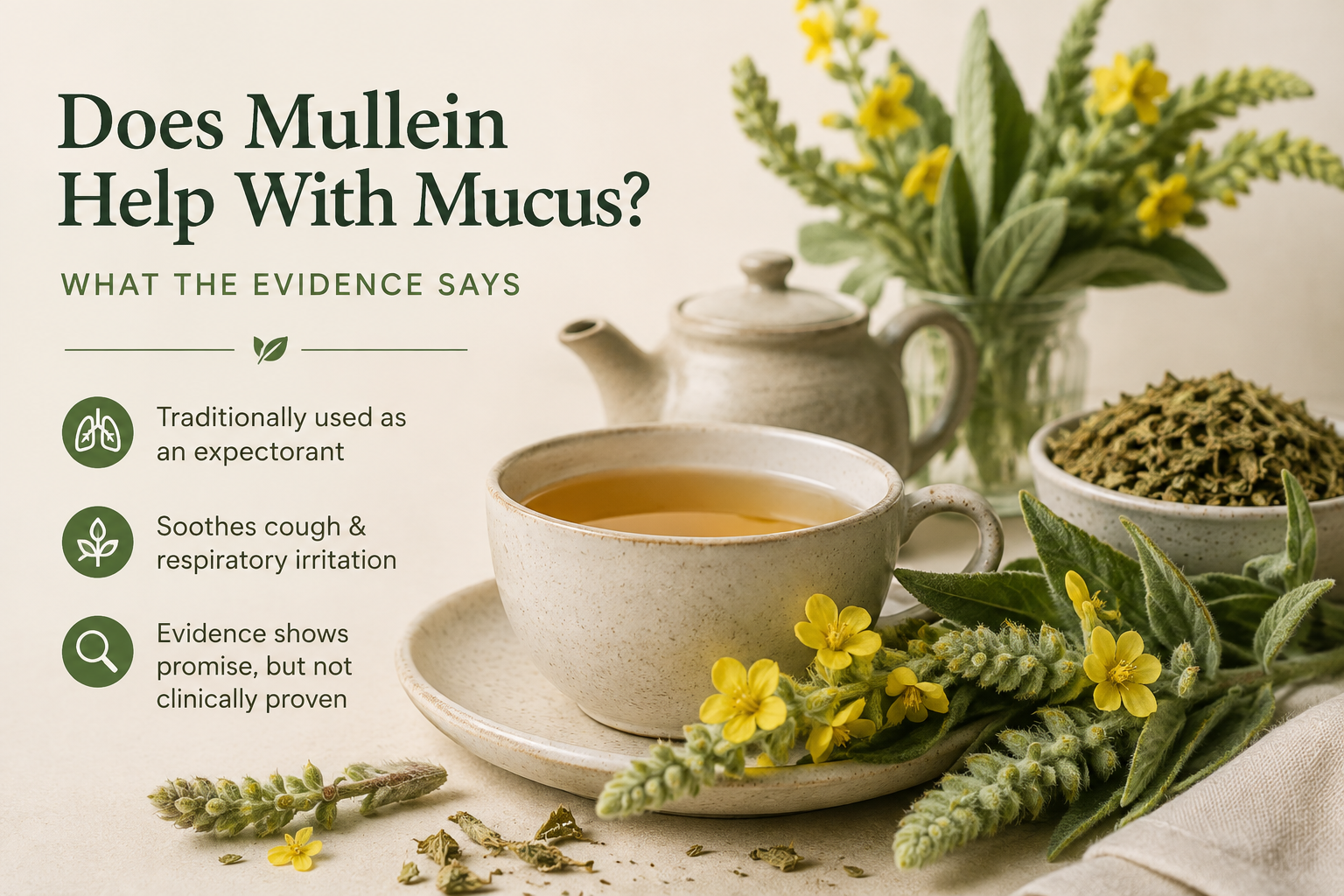
Quick answer: Mullein has a genuine traditional reputation as a mild expectorant, which is why people use terms such as mullein for mucus, mullein for phlegm and mullein expectorant. However, strong human clinical trials have not established that mullein reliably thins mucus, loosens phlegm or clears mucus from the lungs.
The most accurate answer is therefore: mullein has traditional expectorant use, but mucus-clearing effects in humans remain unproven.
Mullein, mucus and phlegm — the key distinction:
| Question | Best evidence-based answer |
|---|---|
| Is mullein an expectorant? | It has historically been described as a mild expectorant in traditional herbal literature. |
| Does mullein loosen mucus? | Not established by strong human clinical trials. |
| Does mullein break up phlegm? | There is insufficient human evidence showing that it reliably thins or breaks up phlegm. |
| Does mullein clear mucus from lungs? | No good clinical evidence shows that mullein physically clears accumulated mucus from lung tissue. |
Short answer: Mullein has a long history of traditional use for cough and respiratory discomfort, and older herbal literature often describes mullein flower as a mild expectorant. However, there is not strong human clinical evidence showing that mullein reliably loosens, breaks up or removes mucus from the lungs.
That distinction matters because phrases such as “mullein for mucus,” “mullein for phlegm” and “natural expectorant” are now common online, while the scientific evidence behind those claims is much less certain.
This guide explains what mucus actually is, why mullein became associated with expectorant use, what researchers know so far, and what remains unproven.
What Is Mucus?
Mucus is a normal substance produced by tissues lining different parts of the body, including the respiratory tract.
In the airways, mucus helps trap:
- dust;
- particles;
- microorganisms;
- and other inhaled material.
The respiratory system normally moves mucus upward so it can eventually be swallowed or coughed out.
When mucus becomes noticeable during a cough, it is commonly called phlegm or sputum.
A cough that brings up mucus is often called a productive cough.
Why Do People Use Mullein for Mucus?
Mullein has been associated with respiratory complaints for centuries.
Historical herbal sources have described mullein flower as both a soothing herb and a mild expectorant.
That history is one of the main reasons modern consumers associate mullein with:
- mucus;
- phlegm;
- chest congestion;
- productive cough;
- and respiratory cleansing.
But historical use and modern clinical evidence are two different things.
For the broader picture, see What Is Mullein? The Complete Guide.
Does Mullein Help With Mucus?
There is a reasonable traditional basis for describing mullein as an herb historically associated with cough and expectorant use.
There is not currently enough high-quality human evidence to conclude that mullein reliably reduces mucus, thins mucus or helps people clear mucus from their lungs.
This means the most accurate answer is:
Mullein has a traditional reputation for expectorant use, but its ability to clear mucus in humans has not been established by strong clinical trials.
This distinction prevents traditional herbal terminology from being presented as proven medical treatment.
Is Mullein an Expectorant?
Mullein is frequently called an expectorant in traditional herbal literature.
An expectorant generally refers to something intended to make respiratory secretions easier to expel through coughing.
The European Medicines Agency’s historical assessment of mullein flower includes references describing it as a mild expectorant for cough and cold symptoms.
However, EMA’s formal traditional-use indication is more limited.
It recognizes mullein flower on the basis of long-standing use for relief of sore throat associated with dry cough and cold.
EMA also notes the lack of clinical studies involving mullein flower medicines.
So the phrase “traditional expectorant” is much more defensible than saying:
“Mullein is clinically proven to clear mucus from the lungs.”
Why Is Mullein Traditionally Considered an Expectorant?
Historical explanations often focus on two groups of plant constituents: mucilage and saponins.
Mucilage
Mucilage refers to plant-derived substances that can form a slippery or gel-like material when mixed with water.
In traditional herbal practice, mucilage-containing herbs are often described as soothing or demulcent.
This may help explain why mullein became associated with irritated throats and cough.
Saponins
Mullein also contains compounds classified as saponins.
Older herbal literature has proposed that these compounds contribute to mullein’s traditional expectorant reputation.
However, the presence of a phytochemical does not automatically tell us what effect drinking mullein tea will produce in a person.
A proposed mechanism is not equivalent to a proven clinical benefit.
Does Mullein Break Up Mucus?
The phrase “break up mucus” is common, but it can mean several different things.
It might refer to:
- making mucus thinner;
- increasing airway secretions;
- making mucus easier to cough up;
- reducing the amount of mucus;
- or improving mucus clearance from the airways.
These are separate biological outcomes.
At present, strong human clinical trials have not established that mullein produces these effects.
Therefore, saying that mullein definitively “breaks up mucus” goes beyond what current evidence can support.
Does Mullein Make You Cough Up Phlegm?
Mullein’s traditional expectorant reputation sometimes leads to the idea that taking mullein will make a person cough up more phlegm.
That effect has not been demonstrated consistently in high-quality human trials.
Some historical herbal references describe preparations intended to encourage expectoration, but historical use should not be interpreted as proof of a predictable physiological response.
People also produce phlegm for many different reasons, so changes in coughing or mucus cannot automatically be attributed to an herb.
Mullein for Mucus vs Mullein for Dry Cough
This is an especially important distinction.
EMA’s recognized traditional-use indication for mullein flower focuses on:
sore throat associated with dry cough and cold.
A dry cough and a productive cough with significant mucus are not the same clinical situation.
| Type of cough | Typical description |
|---|---|
| Dry cough | Little or no mucus is coughed up |
| Productive cough | Mucus or phlegm is coughed up |
This is why evidence concerning traditional use for dry cough should not automatically be turned into a claim that mullein treats excessive lung mucus.
What Does Scientific Research on Mullein Show?
Modern reviews of Verbascum thapsus describe a complex mixture of plant constituents including:
- flavonoids;
- iridoids;
- phenylethanoid glycosides;
- saponins;
- and other phytochemicals.
Experimental studies have investigated mullein extracts for several biological activities.
These include research involving:
- anti-inflammatory activity;
- antioxidant activity;
- antimicrobial activity;
- antiviral activity;
- and other pharmacological effects.
These findings may help researchers understand the plant, but they do not demonstrate that mullein clears mucus from human lungs.
Much of the research is laboratory, chemical, animal or preclinical research rather than controlled human respiratory trials.
Read our Mullein Research page for a deeper explanation of the evidence hierarchy.
Is There Clinical Evidence That Mullein Clears Mucus?
Strong clinical evidence is currently lacking.
This is the most important point when evaluating claims about mullein and phlegm.
A clinical claim would ideally require research showing that people taking a defined mullein preparation experienced measurable outcomes such as:
- reduced sputum volume;
- improved mucus clearance;
- changes in mucus viscosity;
- improved cough-related symptoms;
- or measurable respiratory improvement.
Traditional-use reports cannot substitute for this kind of controlled human evidence.
Does Mullein Reduce Mucus Production?
There is not sufficient clinical evidence demonstrating that mullein reliably reduces mucus production in humans.
This matters because reducing mucus and helping mucus move are not the same thing.
An expectorant would generally be associated with helping secretions become easier to expel rather than necessarily stopping mucus production.
Claims that mullein “stops excess mucus” therefore require evidence separate from claims that it acts as an expectorant.
Can Mullein Clear Mucus From the Lungs?
There is no good evidence showing that mullein physically cleans accumulated mucus from the lungs in the way that some marketing language suggests.
The respiratory system already has mechanisms involved in mucus clearance, including:
- airway mucus;
- cilia lining parts of the respiratory tract;
- and coughing.
Various diseases, infections and environmental exposures can interfere with these processes.
If someone has persistent or unusually heavy mucus production, determining the underlying cause is more important than assuming an herbal product will “clean” the lungs.
Does Mullein Help With Chest Congestion?
“Chest congestion” is another broad term.
People may use it to describe:
- mucus;
- a productive cough;
- tightness;
- wheezing;
- difficulty breathing;
- or simply a heavy sensation in the chest.
These symptoms can have very different causes.
There is insufficient evidence to say that mullein is a clinically proven treatment for chest congestion in general.
Chest tightness or difficulty breathing should especially not be assumed to be a mucus problem that can be treated with an herb.
Does Mullein Help With Mucus From Smoking?
Smokers and former smokers often search for herbs that might help clear phlegm from the lungs.
Smoking can affect mucus production and normal airway clearance mechanisms.
However, there is no good clinical evidence showing that mullein removes smoking residue, tar or accumulated toxins from lung tissue.
It also has not been shown to reverse smoking-related lung damage.
For this specific topic, read Mullein for Smokers: Can It Clean or Repair Your Lungs?
Can Mullein Help With Mucus After Quitting Smoking?
Some people notice coughing or mucus after quitting smoking and then search for mullein as a way to speed up lung recovery.
Mullein’s traditional respiratory use may make it appealing in this situation, but evidence does not establish that it accelerates mucus clearance after smoking cessation.
Quitting smoking itself removes continued exposure to cigarette smoke, which is far more important than relying on an herbal product to compensate for that exposure.
Mullein for Phlegm: Does It Actually Help?
Phlegm is mucus produced in the lower respiratory tract and coughed up as sputum. People often use the phrases “mullein for mucus” and “mullein for phlegm” interchangeably, but the important question is whether mullein has been shown to measurably change mucus clearance in humans.
Mullein has a genuine traditional reputation as an expectorant herb. However, strong human clinical trials have not established that it reliably:
- thins phlegm;
- reduces sputum volume;
- changes mucus viscosity;
- increases mucociliary clearance;
- or makes phlegm leave the lungs faster.
This means traditional expectorant use is a more accurate description than saying mullein is clinically proven to clear phlegm.
Which Form of Mullein Is Used for Mucus?
Different mullein products should not be treated as though they have identical evidence.
- Mullein flower: This is the plant part with the clearest formal European traditional-use documentation. EMA recognizes long-standing use for sore throat associated with dry cough and cold, which is not the same as proving mucus clearance. See Mullein Flower for Lungs.
- Mullein tea: Tea is one of the traditional oral preparations. It may feel soothing, but drinking mullein tea has not been clinically proven to remove mucus from the lungs. See Mullein Tea for Lungs.
- Mullein extract: Liquid extracts and tinctures vary in plant part, solvent and concentration. There is no universal clinically proven extract dose for clearing mucus. See Mullein Extract for Lungs.
- Mullein capsules: Capsules may contain powdered leaf, flower, dry extract or multi-herb blends. There is insufficient evidence showing that capsules reliably clear phlegm. See Mullein Capsules for Lungs.
For a format-by-format comparison, see How to Use Mullein for Lungs.
Dry Cough vs Mucus Cough: Why the Difference Matters
This distinction is especially important for mullein.
The European Medicines Agency’s recognized traditional-use indication for mullein flower concerns sore throat associated with dry cough and cold.
A productive cough with mucus or phlegm is a different symptom pattern.
Therefore, evidence concerning traditional use for dry cough should not automatically be converted into a claim that mullein clears mucus from the lungs.
For the dry-cough evidence specifically, see Mullein for Dry Cough.
Mullein Tea for Mucus
Tea is one of the traditional ways mullein flower has been prepared.
Historical European references describe dried mullein flower being prepared as an herbal infusion.
However, drinking mullein tea has not been clinically proven to clear lung mucus.
Tea also introduces an important product distinction:
Evidence involving mullein flower tea does not automatically apply to mullein leaf, extracts, capsules or inhaled products.
For more detail, read Mullein Tea for Lungs: Benefits, Evidence & How It’s Used.
Mullein Leaf vs Mullein Flower for Mucus
Online discussions frequently use the word “mullein” without identifying which part of the plant is being discussed.
This can create confusion.
EMA’s European herbal monograph concerns mullein flower from specific Verbascum species.
It should not automatically be treated as evidence for every mullein leaf product.
Research conclusions should always be matched to:
- the plant species;
- plant part;
- preparation;
- dose or concentration;
- and route of administration actually studied.
What About Mullein Inhalers for Mucus?
Mullein inhalers and vape-style botanical inhalation products are fundamentally different from herbal tea.
Traditional oral use does not prove that inhaling mullein-containing substances will loosen mucus or improve lung function.
Inhalation also creates a different safety question because ingredients come into direct contact with the respiratory tract.
Evidence from a tea or oral herbal preparation should therefore not be transferred automatically to an inhaled product.
See How to Use Mullein for a comparison of different formats.
Is More Mucus Always Bad?
No.
Mucus is part of the respiratory system’s normal protective function.
The relevant issue is usually whether there has been a meaningful change in:
- amount;
- thickness;
- color;
- odor;
- duration;
- or accompanying symptoms.
This is one reason broad promises to “remove mucus” can be misleading.
The goal is not necessarily to eliminate mucus completely.
What Causes Excess Mucus or Phlegm?
Increased mucus or productive cough can occur for many reasons.
Possible causes include respiratory infections and chronic airway conditions, among others.
Smoking and exposure to respiratory irritants may also contribute.
Because the causes are diverse, persistent phlegm should not automatically be interpreted as something that simply needs an expectorant herb.
When Should Mucus or Phlegm Be Medically Evaluated?
Most occasional coughs are not emergencies, but certain symptoms deserve medical attention.
Seek appropriate medical care if mucus or coughing occurs with concerning symptoms such as:
- difficulty breathing or significant shortness of breath;
- chest pain;
- coughing up blood;
- persistent fever;
- a cough that does not resolve;
- repeated or worsening respiratory symptoms;
- or unusually foul-smelling or concerning sputum.
These symptoms should not be managed simply by adding an herbal product.
What Can We Actually Say About Mullein and Mucus?
| Claim | Evidence status |
|---|---|
| Mullein has a history of respiratory use | Supported by traditional-use records |
| Mullein has historically been described as a mild expectorant | Yes — traditional herbal literature |
| Mullein flower has traditional use for dry cough and sore throat | Recognized in European traditional-use assessment |
| Mullein contains saponins and other phytochemicals | Supported by phytochemical research |
| Mullein is clinically proven to thin mucus | No — insufficient human evidence |
| Mullein is clinically proven to clear phlegm from the lungs | No — insufficient human evidence |
| Mullein removes tar or toxins from smokers’ lungs | Not established |
Does Mullein Help With Mucus? The Bottom Line
Mullein has a genuine traditional history in respiratory herbal practice.
Historical sources have described mullein flower as a mild expectorant, and this helps explain why the plant is now frequently associated with mucus and phlegm.
But the evidence has limits.
There is currently not enough high-quality human clinical evidence to say that mullein reliably thins mucus, breaks up phlegm or clears mucus from the lungs.
The strongest conclusion is therefore that expectorant use is part of mullein’s traditional herbal history rather than a clinically established respiratory effect.
If you want to understand the bigger question of mullein and respiratory health, continue with Is Mullein Good for Your Lungs? What the Evidence Actually Says.
Frequently Asked Questions
Does mullein loosen mucus?
Mullein has traditionally been described as a mild expectorant, but strong human clinical evidence showing that it reliably loosens mucus is lacking.
Does mullein break up phlegm?
There is not sufficient clinical evidence demonstrating that mullein breaks up or thins phlegm in humans.
Does mullein make you cough up mucus?
Historical herbal sources associate mullein with expectorant use, but controlled human studies have not established that taking mullein predictably increases mucus clearance.
Is mullein good for chest congestion?
Mullein has traditional respiratory uses, but it has not been clinically proven to treat chest congestion. Chest symptoms can have many causes, particularly when accompanied by shortness of breath, wheezing or pain.
Does mullein remove mucus from smokers’ lungs?
There is no good evidence showing that mullein removes smoking-related mucus, tar or toxins from the lungs or reverses smoking-related lung damage.
More Questions About Mullein, Mucus & Phlegm
What is the best mullein for mucus?
There is no clinically proven “best” mullein product for clearing mucus. Mullein flower has the clearest formal traditional-use documentation, but that evidence concerns dry cough and cold-related throat discomfort rather than proven mucus clearance.
Does mullein thin phlegm?
There is not enough high-quality human evidence showing that mullein reliably changes phlegm viscosity or makes respiratory mucus thinner.
How long does mullein take to clear mucus?
There is no established clinical timeframe because mullein has not been proven to reliably clear mucus from the lungs. Claims that it clears phlegm within hours or a fixed number of days are not supported by strong human trials.
Is mullein tea or extract better for mucus?
There is insufficient clinical evidence to show that either mullein tea or concentrated extract is superior for mucus clearance. Greater concentration does not automatically mean greater respiratory effectiveness.
Can mullein help mucus after quitting smoking?
Mullein has traditional respiratory uses, but it has not been shown to accelerate mucus clearance after smoking cessation or remove cigarette tar from lung tissue. Stopping continued smoke exposure is much more important than relying on an herbal product to compensate for it.
Mucus clearance is not the same as lung detox. See what evidence actually says about “cleaning” the lungs.
Mucus is only one type of cough-related issue. For the broader question, see Mullein for Cough.
If your main symptom is heaviness or congestion in the chest, see Mullein for Chest Congestion.
For mullein leaf specifically, see Mullein Leaves for Lungs.
For mucus associated with pneumonia, see Mullein for Pneumonia.
For mucus associated with bronchitis, see Mullein for Bronchitis.
For chronic mucus in COPD or chronic bronchitis, see Mullein for COPD.
If mucus occurs with wheezing, see Mullein for Wheezing.
For mucus or cough occurring with asthma, see Mullein for Asthma.
For nasal and sinus congestion as a separate upper-airway issue, see Mullein for Sinus.
References
1. European Medicines Agency.
Verbasci flos — Mullein Flower.
European Union herbal monograph and public summary.
2. European Medicines Agency.
Assessment report on Verbascum thapsus L., Verbascum densiflorum Bertol. and Verbascum phlomoides L., flos.
3. Gupta A, Atkinson AN, Pandey AK, Bishayee A.
Health-promoting and disease-mitigating potential of Verbascum thapsus L. (common mullein): A review.
Phytotherapy Research. 2022;36(4):1507–1522.
DOI: 10.1002/ptr.7393.
4. Turker AU, Gurel E.
Common mullein (Verbascum thapsus L.): recent advances in research.
Phytotherapy Research. 2005;19(9):733–739.
DOI: 10.1002/ptr.1653.
5. MedlinePlus Medical Encyclopedia.
Cough.
U.S. National Library of Medicine.