
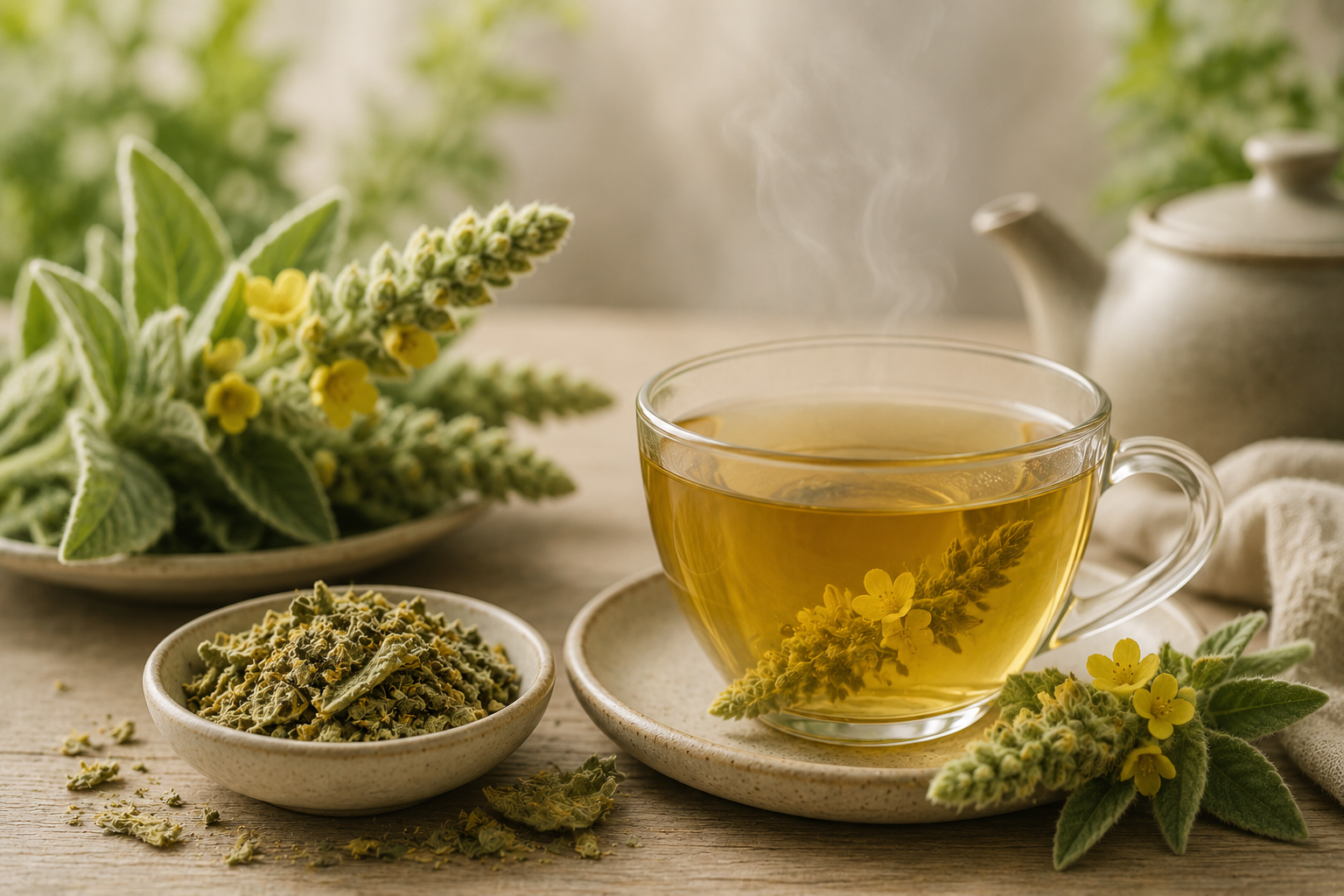
Quick answer: Mullein tea has a genuine history of traditional respiratory use, especially in connection with cough and throat discomfort. However, there is not enough high-quality human evidence to show that drinking mullein tea improves lung function, detoxifies the lungs, removes tar or repairs lung damage.
The most important distinction is between mullein flower tea and mullein leaf tea. Formal European traditional-use documentation specifically concerns mullein flower; that evidence should not automatically be transferred to every leaf tea, extract, capsule or inhaled product.
Mullein tea for lungs — quick evidence guide
| Question | What the evidence supports | Learn more |
|---|---|---|
| Is mullein tea good for your lungs? | It has a traditional respiratory-use history, but broad improvements in lung function have not been established in strong human trials. | Lung Evidence |
| Does mullein tea help cough? | Mullein flower has documented traditional use for sore throat associated with dry cough and cold. | Mullein for Cough |
| Does mullein tea clear mucus? | Mullein has a traditional expectorant reputation, but reliable mucus clearance has not been proven in strong human clinical trials. | Mullein for Mucus |
| Leaf tea or flower tea? | Flower has the clearest formal European traditional-use documentation. Leaf is widely used, but flower evidence should not automatically be treated as leaf evidence. | Flower / Leaf |
| Does mullein tea detox the lungs? | No good human evidence shows that tea removes tar, nicotine residue, pollution particles or unspecified toxins from lung tissue. | Lung Detox Claims |
| How should mullein tea be prepared? | Preparation depends on the specific product and plant part. Loose leaf should be carefully filtered because mullein leaves naturally contain fine hairs. | How to Use Mullein |
Bottom line: mullein tea is best described as a traditional herbal preparation with respiratory associations, not as a clinically proven treatment for lung disease or a method of “cleaning” the lungs.
Short answer: Mullein tea has a long history of traditional respiratory use, particularly in connection with cough and throat discomfort. However, there is not enough high-quality human clinical evidence to conclude that mullein tea improves lung function, cleans the lungs, removes toxins or repairs lung damage.
That makes mullein tea for lungs an interesting topic, but also one where traditional herbal use and modern medical claims need to be kept separate.
This guide explains what mullein tea is, why people associate it with the lungs, what scientific research actually shows, and what you should know before treating claims about “lung detox” as established fact.
What Is Mullein Tea?
Mullein tea is an herbal infusion made from dried material from plants in the Verbascum genus, most commonly Verbascum thapsus, also known as common mullein or great mullein.
Depending on the product, mullein tea may be made from:
- mullein leaves;
- mullein flowers;
- a mixture of leaves and flowers;
- or mullein blended with other herbs.
This distinction matters because different plant parts and commercial preparations should not automatically be assumed to have identical composition or evidence.
If you are new to the plant, start with our complete Mullein Guide.
Why Is Mullein Tea Associated With the Lungs?
Mullein has a long history in traditional herbal practice, particularly for respiratory complaints.
The European Medicines Agency has evaluated mullein flower and recognizes its long-standing traditional use for relief of sore throat associated with dry cough and cold.
This helps explain why mullein became strongly associated with respiratory health.
But the EMA classification is important to understand correctly: it is based on traditional use, not strong modern clinical trials proving that mullein improves lung function.
So there is a meaningful difference between saying:
- “Mullein has traditionally been used for respiratory discomfort.”
and saying:
- “Mullein tea has been clinically proven to heal the lungs.”
The first statement reflects historical use. The second goes beyond the available evidence.
Is Mullein Tea Good for Your Lungs?
The answer depends on what “good for your lungs” means.
Someone asking this question might actually be asking whether mullein tea:
- helps with cough;
- soothes throat irritation;
- reduces mucus;
- improves breathing;
- cleans the lungs;
- repairs lung damage;
- helps after smoking;
- or treats a respiratory disease.
These are different outcomes and require different evidence.
Based on current evidence, it is reasonable to describe mullein tea as a traditional herbal preparation associated with respiratory use.
It is not currently reasonable to describe it as a clinically proven treatment that broadly improves lung health.
For the broader question, see Is Mullein Good for Your Lungs?
What Are the Traditional Benefits of Mullein Tea?
Traditional herbal literature frequently associates mullein with cough, throat discomfort and respiratory irritation.
These historical uses are one reason mullein continues to appear in herbal teas marketed toward people interested in respiratory wellness.
When discussing “mullein tea benefits,” however, it is useful to distinguish three categories:
| Type of claim | What it means |
|---|---|
| Traditional use | The plant has been used for this purpose historically. |
| Laboratory evidence | Extracts or compounds have shown biological activity under experimental conditions. |
| Clinical benefit | Well-designed human research shows a meaningful effect in people. |
Much of mullein’s respiratory reputation belongs to the first category, while modern research has produced interesting findings in the second.
The third category remains much more limited.
What Does Scientific Research on Mullein Show?
Scientific reviews describe Verbascum thapsus as containing multiple classes of plant compounds, including flavonoids, iridoids, phenylethanoid glycosides, saponins and other phytochemicals.
Experimental research has investigated various mullein extracts for biological activities including:
- antioxidant activity;
- anti-inflammatory activity;
- antimicrobial activity;
- antiviral activity;
- and other pharmacological effects.
These findings are scientifically interesting and may help explain why researchers continue to study the plant.
However, most of this evidence does not establish that drinking a cup of mullein tea produces the same effects in human lung tissue.
Interesting plant chemistry is not the same thing as a clinically proven lung benefit.
You can explore this distinction further in our Mullein Research guide.
Does Mullein Tea Help With Cough?
Cough is one of the strongest historical reasons people associate mullein with respiratory use.
Mullein flower has a recognized history of traditional use for sore throat associated with dry cough and cold.
That provides a credible traditional-use basis for the association.
But it should not be converted into a claim that mullein tea is a clinically established cough medicine.
Cough can have many causes, including:
- temporary throat irritation;
- viral infection;
- allergies;
- asthma;
- reflux;
- smoking;
- medication effects;
- or other respiratory conditions.
A persistent, severe or unexplained cough deserves appropriate medical evaluation.
Does Mullein Tea Help Remove Mucus?
Mullein is often described in herbal traditions using terms such as “expectorant,” which contributes to claims that it helps move or remove mucus.
However, strong human clinical evidence demonstrating that mullein tea reliably clears mucus from the lungs is lacking.
It is therefore more accurate to describe mucus-related effects as part of mullein’s traditional respiratory reputation rather than as a clinically proven result.
Does Mullein Tea Clean Your Lungs?
There is no good clinical evidence showing that mullein tea literally “cleans” the lungs.
The lungs already have biological mechanisms that help remove particles and secretions.
Claims that mullein tea:
- flushes toxins from the lungs;
- washes away cigarette chemicals;
- removes tar;
- or performs a “deep lung cleanse”
are stronger than the available evidence supports.
The problem is partly the word clean. It can refer to many different biological outcomes without defining any of them clearly.
Is Mullein Tea a Lung Detox?
“Lung detox” is a popular search phrase, but it is not a clearly defined medical outcome.
There is not sufficient evidence showing that mullein tea detoxifies the lungs in the way that many marketing claims imply.
Traditional respiratory use should not be transformed into statements that an herb removes environmental chemicals, nicotine, smoke residue or other toxins from lung tissue.
Can Mullein Tea Repair Lung Damage?
There is not sufficient human evidence to conclude that mullein tea repairs damaged lung tissue.
This is especially important for smokers and former smokers, who may encounter claims suggesting that herbal tea can reverse years of cigarette exposure.
Smoking-related lung changes can involve inflammation, airway remodeling, loss of lung function and chronic disease.
These processes are much more complex than temporary throat irritation.
For a detailed discussion, read Mullein for Smokers: Can It Clean or Repair Your Lungs?
Is Mullein Tea Good for Smokers?
Smokers and former smokers are commonly interested in mullein tea because of its traditional respiratory reputation.
Someone may choose it as an herbal beverage, but there is no good evidence that drinking mullein tea cancels out the harmful effects of smoking.
It has not been established to:
- remove tar from smokers’ lungs;
- reverse COPD;
- repair smoking-related tissue damage;
- or make continued cigarette smoking safer.
Stopping exposure to cigarette smoke remains far more important for lung health than adding a botanical tea.
How Is Mullein Tea Commonly Prepared?
Commercial mullein tea products are generally prepared by steeping the intended herbal material in hot water.
Because products differ in plant part, quantity and formulation, it is better to follow the preparation instructions provided with the specific tea rather than assuming every mullein product should be prepared identically.
When loose mullein leaf is used, careful filtration is commonly practiced because the leaves naturally have very fine hairs.
A fine tea strainer or suitable filter can help remove loose plant material before drinking.
This page does not provide individualized dosing advice.
What Does Mullein Tea Taste Like?
Mullein tea is generally described as having a mild, earthy and herbal flavor.
Commercial products may taste very different depending on whether they contain:
- leaf;
- flower;
- mint;
- ginger;
- licorice root;
- or other blended herbs.
This is another reason to evaluate the complete ingredient list rather than assuming every product labeled “mullein tea” is the same.
Mullein Leaf Tea vs Mullein Flower Tea
“Mullein tea” can refer to preparations using different plant parts.
This distinction is easy to overlook.
European traditional-use conclusions regarding dry cough and sore throat specifically concern mullein flower.
That evidence should not automatically be generalized to every mullein leaf tea, extract, capsule or inhalation product.
When reading research or product claims, check which plant part was actually studied or used.
Mullein Tea vs Mullein Extract
Tea and extracts should not be treated as equivalent.
Mullein tea is generally a water-based herbal infusion.
An extract may use a different extraction method and may contain a much more concentrated preparation.
Differences can include:
- concentration;
- solvent or extraction method;
- plant part;
- serving size;
- and additional ingredients.
Evidence involving a particular extract cannot automatically be applied to a cup of tea.
Mullein Tea vs Mullein Inhalers
Mullein tea and modern mullein inhalation products are fundamentally different product formats.
Tea is consumed through the digestive system.
An inhalation product exposes the respiratory tract directly to substances that are inhaled or aerosolized.
Evidence about traditional oral use therefore cannot automatically establish the safety or effectiveness of inhalation.
This is particularly important when evaluating nicotine-free mullein vape-style products.
See our How to Use Mullein guide for a full comparison of formats.
Is Mullein Tea Safe?
Safety information for mullein is less complete than many consumers assume.
Botanical origin does not automatically mean that a product is risk-free.
Important considerations include:
- the exact plant species and plant part;
- other ingredients in blended teas;
- possible allergies;
- medications or supplements being used;
- pregnancy or breastfeeding;
- and underlying medical conditions.
Our Mullein Safety Guide explains these issues in more detail.
Can You Drink Mullein Tea Every Day?
There is not enough high-quality evidence to define a universally appropriate daily mullein tea routine for every person.
Commercial formulations vary, and individual health circumstances differ.
For that reason, preparation instructions from the specific product and appropriate professional guidance are more useful than assuming one universal daily quantity applies to everyone.
Who Should Be More Cautious With Mullein Tea?
Extra caution is reasonable for people who:
- are pregnant or breastfeeding;
- take prescription medications;
- have known botanical allergies;
- have significant respiratory symptoms;
- or are considering mullein instead of medical treatment.
Herbal tea should not delay evaluation of persistent shortness of breath, chest pain, coughing up blood, significant wheezing or other concerning respiratory symptoms.
What Can We Reasonably Say About Mullein Tea?
| Claim | Current evidence |
|---|---|
| Mullein has a long history of respiratory use | Yes — traditional use is well documented |
| Mullein flower has traditional use for dry cough and sore throat | Yes — recognized as traditional use |
| Mullein contains biologically interesting plant compounds | Yes — supported by experimental research |
| Mullein tea is clinically proven to improve lung function | No — evidence is insufficient |
| Mullein tea detoxes the lungs | Not established |
| Mullein tea removes tar from smokers’ lungs | Not established |
| Mullein tea repairs damaged lung tissue | Not established |
Bottom Line: Is Mullein Tea Good for Your Lungs?
Mullein tea has a genuine history in traditional respiratory herbal practice.
Mullein also contains phytochemicals that have produced interesting results in experimental research.
What is missing is strong human clinical evidence demonstrating that drinking mullein tea broadly improves lung function, cleans the lungs, detoxifies lung tissue or repairs respiratory damage.
The most accurate conclusion is therefore:
Mullein tea is a traditional herbal preparation associated with respiratory use, but its modern reputation is stronger than the current clinical evidence.
That distinction allows us to respect the history of the plant without turning traditional use into unsupported medical claims.
Next, explore Mullein Research: What Does the Evidence Actually Show?
References
- European Medicines Agency. Verbasci flos — Mullein Flower. Committee on Herbal Medicinal Products.
What Are the Benefits of Mullein Tea for Lungs?
Mullein tea is associated with lung health mainly because of the plant’s long history of traditional respiratory use.
However, it is important to separate traditional use from benefits that have been demonstrated in modern human clinical trials.
Current evidence does not establish that mullein tea reliably:
- improves lung capacity;
- raises oxygen levels;
- opens narrowed airways;
- cleans cigarette tar from the lungs;
- repairs damaged lung tissue;
- or treats asthma, COPD or another chronic respiratory disease.
The clearest formal traditional-use documentation concerns mullein flower and dry cough or cold-related throat discomfort.
For the broader evidence, see Is Mullein Good for Your Lungs?.
Mullein Flower Tea vs Mullein Leaf Tea
This distinction matters because the words “mullein tea” can refer to different plant parts.
Mullein flower tea is closer to the preparation covered by formal European traditional-use documentation.
Mullein leaf tea is also widely used in herbal practice and commercial products, but evidence concerning flower should not automatically be transferred to leaf.
Mullein leaves also have fine surface hairs. When loose leaf is prepared as tea, careful filtering is commonly used to prevent those hairs from remaining in the drink and causing mechanical irritation.
Read:
How to Make Mullein Tea
Mullein tea is an herbal infusion made by steeping dried plant material in hot water and then filtering the liquid before drinking.
The exact preparation depends on whether the product contains flower, leaf, a mixture of plant parts or additional herbs.
For packaged products, follow the preparation instructions supplied with the specific product rather than assuming every mullein tea has the same strength or composition.
If loose mullein leaf is used, careful straining is especially important because the leaf naturally contains fine hairs.
Does Mullein Tea Help a Cough?
Mullein has a genuine traditional association with cough.
The European Medicines Agency recognizes long-standing traditional use of mullein flower for relief of sore throat associated with dry cough and cold.
That conclusion is based on long-standing use rather than strong clinical trials demonstrating that mullein tea reliably treats every type of cough.
See:
Does Mullein Tea Help With Mucus or Phlegm?
Mullein has traditionally been described as an expectorant herb, which is why it is often associated with mucus and phlegm.
However, strong human clinical evidence has not established that drinking mullein tea reliably:
- thins mucus;
- reduces sputum;
- changes mucus viscosity;
- or increases mucus clearance from the lungs.
Traditional expectorant use is therefore more accurate than saying mullein tea is clinically proven to “clear the lungs.”
See Does Mullein Help With Mucus?.
Can Mullein Tea Clean or Detox the Lungs?
There is no good human evidence showing that mullein tea physically removes cigarette tar, nicotine, pollution particles or unspecified toxins from lung tissue.
Drinking an herbal tea and detoxifying lung tissue are not the same biological claim.
See Does Mullein Clean Your Lungs?.
Mullein Tea for Smokers and Former Smokers
Smokers and people who recently quit may become interested in mullein tea because of cough, mucus or concerns about lung recovery.
Mullein tea has not been shown to reverse smoking-related structural lung damage or remove cigarette tar.
Someone may choose it as an herbal beverage, but it should not be presented as a substitute for stopping continued smoke exposure or receiving appropriate medical care.
See Mullein for Smokers.
How Often Can You Drink Mullein Tea?
There is no single evidence-based daily schedule that applies to every commercial mullein tea.
Products may differ in:
- plant part;
- amount of dried herb;
- species;
- blend ingredients;
- and preparation strength.
For this reason, use directions should be based on the specific product rather than treating all mullein teas as interchangeable.
People taking medications, using multiple supplements, pregnant or breastfeeding, or living with a significant health condition should be particularly cautious about assuming that an herbal product has no interaction or safety considerations.
Mullein Tea vs Extract and Capsules
Tea, extracts and capsules are different preparations.
A concentrated tincture is not automatically more effective than tea, and a capsule does not automatically deliver the same constituents as a flower infusion.
The product format alone cannot tell you whether a lung-health claim has been clinically demonstrated.
Compare:
More Questions About Mullein Tea for Lungs
Is mullein tea actually good for your lungs?
Mullein tea has a genuine history of traditional respiratory use, but high-quality human evidence showing broad improvements in lung function is limited.
What does mullein tea do for your lungs?
The strongest supported statement is that mullein has traditional associations with cough and respiratory discomfort. Mullein tea has not been clinically proven to detox, repair or broadly improve the lungs.
Is mullein leaf or flower better for tea?
Mullein flower has the clearest formal European traditional-use documentation for dry cough and cold-related throat discomfort. Leaf is also commonly used, but flower evidence should not automatically be treated as leaf evidence.
Should mullein tea be strained?
Loose mullein leaf has fine hairs, so careful filtering helps prevent plant hairs from remaining in the finished tea and causing mechanical irritation.
Can you drink mullein tea every day?
There is no universal evidence-based daily regimen that applies to every mullein tea. Product composition and strength vary, so the specific preparation instructions matter.
How long does mullein tea take to work?
There is no established clinical timeframe showing how quickly mullein tea should create a measurable lung benefit. Fixed claims such as “clears lungs in three days” are not supported by strong evidence.
Does mullein tea clear mucus?
Mullein has a traditional expectorant reputation, but strong human evidence showing that tea reliably clears mucus or phlegm from the lungs is limited.
Can mullein tea repair smokers’ lungs?
No good clinical evidence shows that mullein tea reverses smoking-related structural lung damage or removes cigarette tar.
Additional Safety Source
National Center for Complementary and Integrative Health.
Dietary and Herbal Supplements
For safety considerations, see Mullein Side Effects & Safety.
For tea used specifically for throat discomfort, see Mullein for Sore Throat.
For tea used during a common cold, see Mullein for Cold.
For tea use specifically during influenza, see Mullein for Flu.
For dosage questions across different mullein formats, see Mullein Dosage.
For why oral tea should not be used as a homemade nasal rinse, see Mullein for Sinus.