
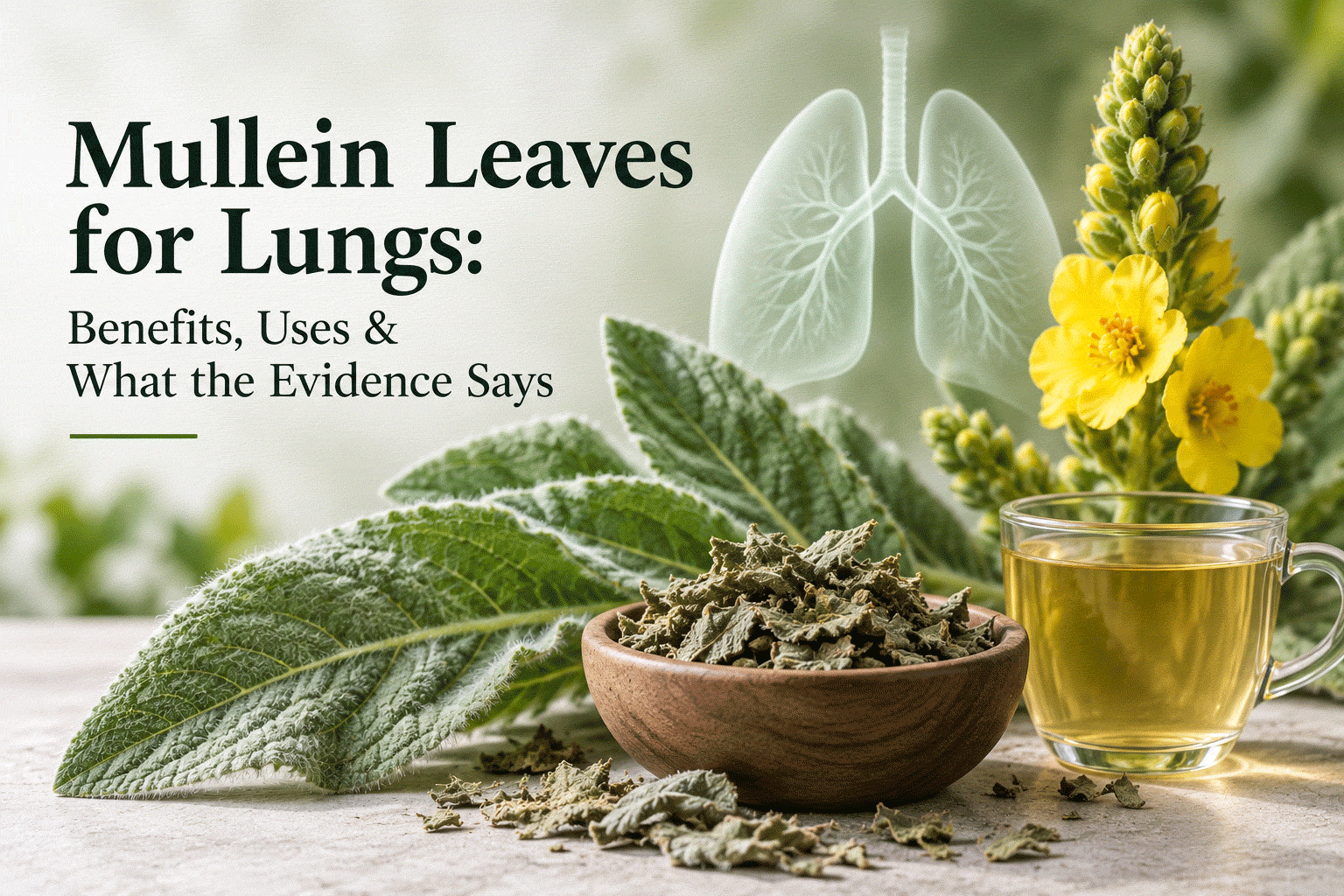
Quick answer: Mullein leaves have a genuine history of traditional respiratory use, but there is not enough strong human clinical evidence to show that mullein leaf improves lung function, clears mucus reliably, detoxifies the lungs or repairs lung damage.
The most important point is that mullein leaf and mullein flower are different plant parts with different evidence contexts. The European Medicines Agency’s formal traditional-use monograph concerns mullein flower, not mullein leaf generally.
Mullein leaves for lungs — quick evidence guide
| Question | What the evidence supports | Related guide |
|---|---|---|
| Are mullein leaves good for your lungs? | Mullein leaf has a long respiratory-use history, but broad improvements in human lung function have not been established in strong clinical trials. | Lung Evidence |
| Leaf or flower? | They are different plant parts. Formal European traditional-use documentation specifically concerns mullein flower. | Mullein Flower |
| Can you make tea from mullein leaves? | Yes. Dried leaf is commonly used for tea, but loose preparations should be carefully filtered because the fuzzy leaf contains fine hairs. | Mullein Tea |
| Do mullein leaves help mucus? | Mullein has a traditional expectorant reputation, but reliable mucus clearance from leaf preparations has not been established in strong human trials. | Mullein for Mucus |
| Do mullein leaves help cough? | Mullein has a traditional association with cough, but flower-specific traditional-use evidence should not automatically be treated as proof for leaf products. | Mullein for Cough |
| Do mullein leaves clean the lungs? | No good human evidence shows that mullein leaf removes cigarette tar, pollution particles or unspecified toxins from lung tissue. | Lung Detox Claims |
| Can you smoke mullein leaves? | Dried leaf can be burned, but combustion creates smoke exposure. Traditional oral-use evidence does not establish benefits from smoking the leaf. | Mullein Smoking |
Bottom line: mullein leaf has a meaningful traditional history and interesting experimental research, but modern claims about “lung cleansing,” mucus removal and lung repair are stronger than the available human evidence.
Short answer: Mullein leaves have a long history in traditional herbal practice, including use in preparations associated with cough, throat discomfort and respiratory complaints. However, there is not strong human clinical evidence showing that mullein leaves broadly improve lung function, clean the lungs, repair damage or treat respiratory disease.
There is also an important distinction that is often missed online:
Mullein leaf and mullein flower are not automatically supported by the same evidence.
Scientific reviews discuss both dried leaves and flowers of Verbascum thapsus, but the European Medicines Agency’s formal traditional-use monograph specifically concerns mullein flower.
This guide explains what mullein leaves are, why they became associated with lung health, what research actually tells us, and where claims about mullein leaves for lungs go beyond the evidence.
What Are Mullein Leaves?
Mullein leaves are the large, soft, gray-green leaves of plants in the Verbascum genus.
The species most commonly discussed in modern herbal products is Verbascum thapsus, often called:
- common mullein;
- great mullein;
- or simply mullein.
The plant is a biennial herb known for its dense, velvety leaves and tall yellow flower spike.
Mullein leaves are covered with fine branching hairs, or trichomes, which give them their characteristic fuzzy appearance.
The leaves have been used historically in different herbal preparations, while mullein flowers have their own separate history of traditional use.
For an introduction to the entire plant, see What Is Mullein? The Complete Guide.
Why Are Mullein Leaves Associated With the Lungs?
Mullein has a long reputation in traditional herbal medicine for respiratory complaints.
Scientific reviews of Verbascum thapsus describe historical use in connection with:
- cough;
- throat complaints;
- pulmonary problems;
- respiratory discomfort;
- and other traditional medicinal uses.
Both leaves and flowers appear in historical and commercial herbal preparations.
This traditional history helps explain why phrases such as:
- “mullein leaves for lungs”;
- “mullein leaf lung benefits”;
- “mullein leaf for mucus”;
- and “mullein leaf for cough”
are now common search terms.
But traditional use should not automatically be translated into modern claims about detoxification, lung repair or treatment of respiratory disease.
Are Mullein Leaves Good for Your Lungs?
That question is broader than it first appears.
Someone asking whether mullein leaves are “good for the lungs” might actually be asking whether they:
- soothe a cough;
- help with mucus;
- relieve throat irritation;
- improve breathing;
- clean the lungs;
- help smokers;
- repair lung damage;
- or treat a respiratory condition.
These are different claims and require different kinds of evidence.
The current evidence supports saying that mullein has a significant traditional respiratory history and contains biologically interesting plant compounds.
It does not support saying that mullein leaves are clinically proven to improve lung health in general.
For the broader question, see Is Mullein Good for Your Lungs?
Mullein Leaf vs Mullein Flower: Why the Difference Matters
This is one of the most important distinctions on MulleinForLungs.com.
People often use the word “mullein” as though every plant part has identical evidence.
That is not accurate.
| Plant part | Evidence context |
|---|---|
| Mullein leaf | Traditional use, commercial herbal preparations and experimental research are documented |
| Mullein flower | Traditional use plus a specific European Medicines Agency herbal monograph |
The European Medicines Agency monograph concerns Verbascum flower, not mullein leaf generally.
EMA recognizes mullein flower, on the basis of long-standing traditional use, for relief of sore throat associated with dry cough and cold.
It also notes the lack of clinical studies.
Therefore, that European traditional-use conclusion should not simply be rewritten as:
“Mullein leaf is clinically proven to treat cough.”
That would go beyond the evidence.
How to Use Mullein Leaves for Lungs
Mullein leaves are commonly used in several modern herbal formats, but the route of use matters because tea, capsules, extracts and smoke are not equivalent.
- Leaf tea: dried mullein leaf is steeped in hot water and carefully filtered before drinking.
- Capsules: may contain powdered leaf, aerial parts or concentrated extract.
- Liquid extracts: vary substantially in solvent, concentration and plant-to-extract ratio.
- Smoking blends: involve combustion and should not inherit the evidence associated with oral herbal preparations.
There is no single clinically established mullein-leaf regimen for improving lung function, clearing mucus or “detoxing” the lungs.
For a full comparison of the different formats, see How to Use Mullein for Lungs.
Mullein Leaf Benefits for Lungs: What Can We Actually Say?
The most defensible conclusion is that mullein leaf has a genuine traditional respiratory history and has been included in herbal preparations associated with cough and respiratory discomfort.
However, strong human clinical evidence does not currently establish that mullein leaf:
- improves measurable lung function;
- opens narrowed airways;
- reliably clears mucus or phlegm;
- repairs smoking-related lung damage;
- removes cigarette tar;
- or treats asthma, COPD or bronchitis.
This is also where the distinction between mullein leaf and mullein flower becomes important. The European Medicines Agency’s formal traditional-use monograph concerns mullein flower, not mullein leaf generally.
Compare the evidence in Mullein Flower for Lungs and Mullein Research.
Mullein Leaf Tea vs Flower Tea
Leaf tea and flower tea are both herbal preparations, but they should not be treated as evidence-equivalent.
Flower tea is closer to the plant part covered by formal European traditional-use documentation for sore throat associated with dry cough and cold.
Leaf tea is widely used in herbal practice and commercial products, but the flower monograph should not be rewritten as direct clinical proof for leaf.
Loose mullein leaf should also be filtered carefully because the leaf naturally contains fine hairs that can remain in poorly filtered tea.
Mullein Leaves for Mucus and Phlegm
Mullein leaf is often associated with mucus because of the herb’s traditional expectorant reputation.
However, strong human evidence has not established that mullein leaf reliably changes mucus viscosity, reduces sputum volume or increases mucus clearance from the lungs.
For that specific question, see Does Mullein Help With Mucus?.
Can You Smoke Mullein Leaves?
Dried mullein leaf is sometimes used in herbal smoking blends, but burning the leaf creates smoke and combustion products.
Traditional oral-use evidence should therefore not be interpreted as proof that smoking mullein leaves benefits the lungs.
See Mullein Smoking: Can You Smoke Mullein Safely?.
What Does Research on Mullein Leaf Show?
Scientific literature on Verbascum thapsus describes a wide range of phytochemicals and experimental biological activities.
Reviews identify classes of compounds including:
- flavonoids;
- iridoids;
- phenylethanoid glycosides;
- phenylpropanoid glycosides;
- saponins;
- and other plant constituents.
Experimental studies involving different parts or extracts of mullein have explored properties such as:
- antioxidant activity;
- anti-inflammatory activity;
- antimicrobial activity;
- antiviral activity;
- and other pharmacological effects.
These findings help researchers understand the plant.
They do not prove that drinking mullein leaf tea or taking mullein leaf products produces the same effects in human lungs.
Plant chemistry and laboratory activity are not the same thing as a clinically proven lung benefit.
Read Mullein Research for a full explanation of this evidence hierarchy.
Are There Human Clinical Trials on Mullein Leaves for Lungs?
Strong modern human clinical evidence is limited.
This is the central limitation behind many mullein claims.
To establish a meaningful lung benefit, researchers would ideally need controlled human studies measuring outcomes such as:
- cough severity;
- mucus clearance;
- lung function;
- airflow;
- respiratory symptoms;
- or disease-related outcomes.
Traditional use and laboratory research can help generate hypotheses, but they do not replace controlled clinical trials.
What Are the Traditional Benefits of Mullein Leaf?
Traditional herbal literature has associated mullein with a range of respiratory uses.
Depending on the tradition and preparation, mullein leaf has been discussed in connection with:
- cough;
- throat irritation;
- respiratory discomfort;
- mucus;
- and herbal tea preparations.
These are important historical uses.
But the phrase traditional benefit should not be interpreted as meaning that every effect has been confirmed in modern human trials.
Do Mullein Leaves Help With Cough?
Mullein’s connection with cough is one of its best-known traditional associations.
However, the strongest formal European traditional-use conclusion specifically concerns mullein flower, not leaf.
That makes it important to avoid using flower-specific regulatory evidence as direct proof for every mullein leaf product.
There is not enough strong human evidence to say that mullein leaf reliably treats all types of cough.
For the complete cough discussion, read Mullein for Cough: Does It Actually Help?.
Do Mullein Leaves Help With Mucus?
Mullein is often described in traditional herbal literature as an expectorant.
This contributes to the idea that mullein leaves can help loosen mucus or phlegm.
However, strong human clinical evidence showing that mullein leaf reliably:
- thins mucus;
- reduces mucus;
- breaks up phlegm;
- or increases mucus clearance
is lacking.
A traditional expectorant reputation is not the same thing as a clinically measured mucus-clearing effect.
See Does Mullein Help With Mucus?
Can Mullein Leaves Clean Your Lungs?
There is no good clinical evidence showing that mullein leaves literally clean or detoxify human lungs.
Claims that mullein leaf:
- flushes toxins;
- removes cigarette tar;
- extracts nicotine;
- clears environmental pollution;
- or washes harmful substances out of lung tissue
are not established by current evidence.
“Lung cleanse” is also not a clearly defined medical outcome.
Read Does Mullein Clean Your Lungs? Detox Claims vs Evidence.
Can Mullein Leaves Repair the Lungs?
There is not sufficient clinical evidence showing that mullein leaves repair structural lung damage.
Repairing lung tissue could mean many different things, including:
- restoring lost lung function;
- reversing airway injury;
- reversing emphysema;
- reducing permanent scarring;
- or reversing smoking-related damage.
These are major medical outcomes.
Laboratory antioxidant or anti-inflammatory findings do not establish that these effects occur in people taking mullein leaf.
Are Mullein Leaves Good for Smokers?
Smokers and former smokers are particularly interested in mullein because of its respiratory reputation.
But there is no good evidence showing that mullein leaves remove the damage caused by cigarette smoke.
Mullein leaf has not been shown to:
- remove tar from the lungs;
- reverse emphysema;
- repair COPD;
- restore damaged lung tissue;
- or make continued smoking safer.
For that topic, see Mullein for Smokers: Can It Clean or Repair Your Lungs?
Mullein Leaf Tea for Lungs
Tea is one of the most common ways mullein leaves are used today.
Commercial mullein teas may contain:
- dried mullein leaf;
- mullein flower;
- a mixture of leaf and flower;
- or mullein blended with other herbs.
That means two products sold as “mullein tea” may not contain the same plant part.
This distinction matters when comparing a product with research or traditional-use documents.
Tea should be understood as a botanical preparation rather than a proven treatment for lung disease.
For the dedicated guide, read Mullein Tea for Lungs: Benefits, Evidence & How It’s Used.
Why Does Mullein Leaf Feel Fuzzy?
Mullein leaves have a distinctive soft or woolly surface because they are covered in dense plant hairs called trichomes.
These structures are part of the natural anatomy of the leaf.
The fuzzy surface is one of the easiest ways to recognize common mullein in the field.
It is also relevant when loose leaf material is prepared as tea.
Should Mullein Leaf Tea Be Filtered?
Fine filtration is commonly recommended when preparing loose mullein leaf tea.
The reason is practical rather than medicinal: tiny hairs from the leaves can remain in poorly filtered tea and may feel irritating in the mouth or throat.
Commercial tea bags or professionally processed preparations may handle filtration differently.
If using loose plant material, follow the preparation instructions provided with the specific product rather than assuming every mullein product is prepared identically.
Mullein Leaf vs Mullein Leaf Extract
Dried leaf and concentrated extracts are not equivalent preparations.
An extract may differ in:
- concentration;
- extraction solvent;
- plant-to-extract ratio;
- chemical composition;
- and serving size.
Evidence from one preparation should not automatically be applied to another.
A stronger concentration also does not turn an unproven benefit into a proven one.
Mullein Leaf vs Mullein Capsules
Mullein capsules may contain:
- powdered leaf;
- powdered aerial parts;
- extract;
- or combinations with other herbs.
The word “mullein” on the front of a supplement does not necessarily identify exactly what is inside.
When comparing products, check:
- the species;
- plant part;
- form;
- other ingredients;
- and serving information.
Can You Smoke Mullein Leaves?
Dried mullein leaf is sometimes included in herbal smoking blends.
That does not mean smoking it is proven beneficial for the lungs.
Burning plant material produces smoke and combustion products.
Traditional use of mullein as a botanical preparation should not be interpreted as evidence that inhaling burned mullein leaf is good for respiratory health.
We cover that question separately in Mullein Smoking: Is Smoking Mullein Safe for Your Lungs?.
Mullein Leaves vs Mullein Vape
A dried mullein leaf and a mullein vape are fundamentally different products.
A mullein vape generally refers to an electronic product that creates an inhaled aerosol.
Traditional leaf or flower use does not prove that aerosolized mullein-containing formulations produce the same effects.
Likewise, evidence concerning a dried herb cannot automatically establish inhalation safety.
See Mullein Vape: What It Is, Safety & What the Evidence Says.
Does Mullein Leaf Reduce Inflammation in the Lungs?
Experimental research has reported anti-inflammatory activity involving mullein extracts.
That does not establish that consuming mullein leaf reduces inflammation in human lung tissue.
To make that clinical claim, studies would need to demonstrate meaningful respiratory outcomes in people using a clearly defined preparation.
The evidence is not currently strong enough to make that conclusion.
Does Antioxidant Activity Mean Mullein Leaf Protects the Lungs?
No.
Antioxidant activity measured in laboratory systems is not equivalent to proven protection of human lungs.
Important questions would include:
- whether the compounds are absorbed;
- what concentrations reach relevant tissues;
- how they are metabolized;
- and whether measurable health outcomes change.
Without that evidence, “antioxidant” should not be converted into claims that mullein prevents or repairs lung disease.
Can Mullein Leaf Treat Asthma?
There is not sufficient human clinical evidence showing that mullein leaf treats asthma.
Asthma is a chronic respiratory condition involving airway inflammation and variable airflow obstruction.
A herbal product should not replace prescribed asthma medication or an asthma action plan.
Persistent wheezing or breathing difficulty should be medically evaluated.
Can Mullein Leaf Treat COPD?
No strong clinical evidence shows that mullein leaf treats or reverses COPD.
Claims that mullein can restore permanently damaged lungs or reverse emphysema go beyond current evidence.
People with diagnosed COPD should not substitute mullein for evidence-based respiratory treatment.
Can Mullein Leaf Treat Bronchitis?
Mullein’s traditional connection with cough can lead to claims about bronchitis.
But cough is a symptom, while bronchitis is a condition involving inflammation of the bronchial airways.
Traditional cough use does not establish that mullein leaf treats the underlying cause of bronchitis.
Does Mullein Leaf Fight Respiratory Infections?
Laboratory research involving mullein extracts has explored antimicrobial and antiviral activity.
These findings are interesting but should not be interpreted as evidence that mullein leaf cures respiratory infections in humans.
Mullein should not be presented as a replacement for appropriate treatment of pneumonia, influenza, COVID-19 or another respiratory infection.
How Is Mullein Leaf Commonly Used?
Modern mullein leaf products can appear in several formats.
| Format | Typical route |
|---|---|
| Dried leaf tea | Oral |
| Capsules | Oral |
| Liquid extract or tincture | Usually oral |
| Herbal smoking blend | Smoke inhalation |
| Modern vape-style product | Aerosol inhalation |
These formats should not be treated as interchangeable.
The route of exposure changes both the evidence question and the safety question.
See How to Use Mullein for a complete format comparison.
Is Mullein Leaf Safe?
Available safety information is less complete than many consumers assume.
Important factors include:
- the exact plant species;
- which plant part is used;
- product quality;
- other ingredients;
- the preparation method;
- medications;
- pregnancy or breastfeeding;
- allergies;
- and underlying health conditions.
“Natural” does not automatically mean “appropriate for everyone.”
See our Mullein Safety Guide for the broader safety discussion.
Can You Use Mullein Leaf Every Day?
There is not enough high-quality clinical evidence to define one universally appropriate daily mullein leaf routine for every person.
Products also vary substantially in preparation and concentration.
That makes product-specific instructions and individual health circumstances more relevant than assuming one standard daily amount applies to everyone.
What Should You Look for in a Mullein Leaf Product?
Useful product information includes:
- the botanical species;
- whether the product uses leaf, flower or another plant part;
- the form of the ingredient;
- the complete ingredient list;
- preparation instructions;
- manufacturer information;
- and realistic rather than exaggerated health claims.
A product should be treated cautiously if it promises that mullein leaf can:
- detox the lungs;
- remove years of cigarette tar;
- reverse COPD;
- cure asthma;
- repair damaged lung tissue;
- or replace prescribed respiratory treatment.
What Can We Actually Say About Mullein Leaves for Lungs?
| Claim | Evidence status |
|---|---|
| Mullein leaves have a history of traditional use | Yes |
| Dried mullein leaves are used in modern herbal preparations | Yes |
| Mullein contains biologically interesting phytochemicals | Supported by experimental research |
| EMA’s formal mullein monograph specifically covers mullein flower | Yes |
| Mullein leaf is clinically proven to improve lung function | No |
| Mullein leaf is clinically proven to clear mucus | No |
| Mullein leaf detoxes the lungs | Not established |
| Mullein leaf repairs smoking damage | Not established |
| Mullein leaf treats asthma or COPD | Not established |
Mullein Leaves for Lungs: The Bottom Line
Mullein leaves have a genuine place in the traditional history of Verbascum thapsus and are widely used in modern herbal preparations.
Scientific reviews also show that the plant contains a diverse range of phytochemicals and has generated interesting experimental research.
But the evidence has important limitations.
There is not enough strong human clinical evidence to say that mullein leaves broadly improve lung function, clean the lungs, clear mucus, repair smoking damage or treat chronic respiratory disease.
It is also important not to transfer evidence automatically between plant parts.
The European Medicines Agency’s formal traditional-use conclusions concern mullein flower, not every mullein leaf product.
The most accurate conclusion is therefore:
Mullein leaf has a meaningful traditional respiratory history and interesting experimental research, but many modern “lung benefit” claims remain stronger than the available human evidence.
Continue with Mullein Research: What Does the Evidence Actually Show?.
Frequently Asked Questions
Are mullein leaves good for your lungs?
Mullein leaves have a long history of traditional respiratory use, but there is not enough strong clinical evidence to say that they broadly improve human lung function.
What are mullein leaves used for?
Mullein leaves have traditionally been used in herbal preparations associated with cough and respiratory complaints and are now commonly sold as dried tea material, extracts and supplements.
Are mullein leaf and mullein flower the same?
No. They come from the same plant but are different plant parts. This matters because the European Medicines Agency’s formal traditional-use monograph specifically concerns mullein flower.
Do mullein leaves help with mucus?
Mullein has a traditional expectorant reputation, but strong human evidence showing that mullein leaf reliably clears mucus or phlegm is lacking.
Does mullein leaf clean your lungs?
There is no good clinical evidence showing that mullein leaf removes tar, nicotine, pollutants or unspecified toxins from human lung tissue.
Can mullein leaf repair damaged lungs?
There is insufficient clinical evidence showing that mullein leaf repairs structural lung damage or restores lost lung function.
Can you make tea from mullein leaves?
Dried mullein leaf is commonly sold for herbal tea. Loose leaf preparations should be filtered carefully because the leaves naturally have dense fine hairs that may remain in poorly filtered liquid.
Can you smoke mullein leaves?
Dried mullein is sometimes used in herbal smoking blends, but there is no good evidence showing that inhaling burned mullein leaf benefits the lungs. Burning plant material creates smoke and combustion products.
More Questions About Mullein Leaves
How do you use mullein leaves for lungs?
Mullein leaves are commonly used as filtered herbal tea, powdered supplements or extracts. There is no clinically established mullein-leaf routine proven to improve general lung function, so the exact preparation and product instructions matter.
What are the benefits of mullein leaves for lungs?
Mullein leaf has a long traditional respiratory-use history, but broad modern claims such as lung detoxification, lung repair or reliable improvement in lung function have not been established by strong human clinical trials.
Is mullein leaf better than mullein flower?
Not necessarily. The two plant parts have different evidence contexts. Mullein flower has the clearer formal European traditional-use documentation, while leaf is widely used in herbal products and has its own traditional and experimental literature.
Do you need to strain mullein leaf tea?
Careful filtering is commonly recommended for loose mullein leaf because the leaves have dense fine hairs that can remain in poorly filtered tea and cause mechanical irritation.
For comparison with the root, see Mullein Root for Lungs.
References
1. Gupta A, Atkinson AN, Pandey AK, Bishayee A.
Health-promoting and disease-mitigating potential of Verbascum thapsus L. (common mullein): A review.
Phytotherapy Research. 2022;36(4):1507–1522.
PMID: 35088467. DOI: 10.1002/ptr.7393.
2. Turker AU, Gurel E.
Common mullein (Verbascum thapsus L.): recent advances in research.
Phytotherapy Research. 2005;19(9):733–739.
PMID: 16222647. DOI: 10.1002/ptr.1653.
3. European Medicines Agency.
Verbasci flos — Mullein Flower.
Committee on Herbal Medicinal Products.
4. European Medicines Agency.
Assessment report on Verbascum thapsus L., Verbascum densiflorum Bertol. and Verbascum phlomoides L., flos.
The assessment concerns mullein flower and traditional use for sore throat associated with dry cough and cold.
5. Ahmad M, et al.
Micromorphology, pharmacognosy, and bio-elemental analysis of an important medicinal herb: Verbascum thapsus L.
Microscopy Research and Technique. 2020.
PMID: 32027460.